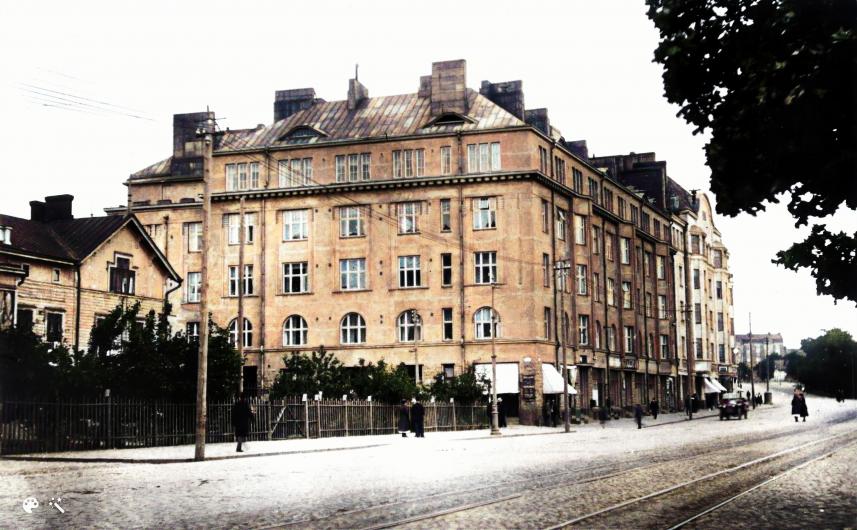

The Kaiku Block Area Before the Stone Buildings
The present-day Hämeentie 26 is located in the Kallio district, in an area whose history extends far beyond what the surrounding closed urban block structure might suggest at first glance. Before the era of Jugend stone buildings, the area was sparsely populated and dominated by natural landforms—a peripheral zone forming part of the long process in which the City of Helsinki expanded northwards toward Sörnäinen and Kallio.
On the Outskirts of the City – Lands of Töölö Village
In the 17th century, the present Kallio area belonged to Töölö village, which was donated to the City of Helsinki in 1650. For a long time, the northern side of Pitkäsilta remained outside the city’s actual built-up area. The land was mainly used as common pasture by townspeople, and there was no permanent construction. As late as the early 19th century, maps still depicted the area as an undeveloped, rural fringe on the edge of the city.
From Leasehold Plots to Villas
A significant change occurred in 1845, when the City of Helsinki divided the area between Pitkäsilta and Vanhakaupunki into 42 equally sized leasehold plots. These plots, located outside the built city, were intended for cultivation or villa settlement. As a result of this arrangement, the first villas and villa districts along Hämeentie began to emerge.
Many present-day place names—such as Hakaniemi, Kallio and Kaiku—originate from these villa plots. In the mid-19th century, Kallio and Kaiku were still areas dominated by steep rocky outcrops and dense forest, far removed from today’s urban character.
The Kaiku Plot and Itäinen Viertotie
The land area at what is now Hämeentie 26 formed part of the extensive villa plot known as Kaiku (plot no. 26), covering approximately 12 hectares. The entire area belonged to the villa settlement zone situated along Itäinen Viertotie.
Itäinen Viertotie—today’s Hämeentie—was completed in 1864. The plots along the road were functionally divided into two: the seaward side was largely reserved for industrial use, while residential villas were built on the opposite side. Although the villas were originally intended as leisure residences, as the city expanded they gradually became areas of permanent habitation.
From Villa Community to Stone City
The official subdivision plan for the plots along Itäinen Viertotie was completed in 1893. Soon thereafter, the loosely built villa community began to give way to a denser stone-built urban structure. The official town plan for Kallio was confirmed in 1901, creating the preconditions for large-scale stone construction.
The lease agreement for the Kaiku plot expired in 1906, after which the villas were demolished and the area reorganized. In this process, the current building site of Hämeentie 26 was redefined: it became plot no. 23 in block 331, as part of the Torkkelinmäki sub-area.
The Emergence of a Giant Block
In the early years of the 20th century, block 331 began to take shape as an exceptionally large urban block in the context of Kallio. Construction of Jugend-style stone buildings started at the lower end of Kaikukuja as early as 1908. Hämeentie developed rapidly: Hämeentie 30 was completed in 1910, Hämeentie 28 in 1911, and shortly thereafter Hämeentie 26.
By this stage, the Kaiku block had definitively transitioned from a villa landscape into part of the urban, stone-built Kallio—a development that mirrors the broader transformation of Helsinki from a small coastal town into a modern capital city.